

Day trading for a living is an attractive idea. The freedom to work from anywhere, set your own schedule, and potentially earn money from the stock market is something many people dream about.
But there's a significant difference between placing a few profitable trades and building a consistent income from day trading.
Experienced traders don't simply open their trading platforms each morning and hope to find something worth buying. They follow a process. They know what they're looking for, understand their risk, and focus on stocks that offer genuine trading opportunities.
And perhaps most importantly, they understand that not every stock is worth trading, and not every day requires a trade.

In this guide, we'll explore what it really takes to day trade for a living, the strategies and tools traders use, and how to find stocks that are actually worth your attention.
1. Understand What Day Trading Actually Involves
Day trading involves buying and selling financial instruments within the same trading day, attempting to profit from short-term price movements.
Unlike long-term investing, where you might hold shares for months or years, day traders focus on what is happening in the market right now.
For example, a company might release unexpectedly strong earnings before the market opens. Its share price rises, trading volume increases, and traders begin watching for further opportunities.
A day trader might look to enter a position after the opening bell, capture part of the price movement, and close the trade before the end of the session.
However, day trading carries substantial financial risk. Even experienced traders can suffer significant losses, particularly when using leverage.
The objective isn't to win every trade. It's to develop a repeatable process that can produce positive results over a meaningful period, after losses and trading costs.
2. How Much Money Do You Need to Day Trade for a Living?
This is one of the most important questions aspiring day traders should ask.
The amount of capital required depends on your living expenses, trading strategy, risk tolerance, and the markets you trade.
Someone who needs £2,000 per month to cover their expenses has a very different financial target from someone who needs £5,000.
But there's a fundamental problem with calculating how much capital you need based on a desired monthly return.
The stock market doesn't provide a guaranteed monthly salary.
You might have a profitable month followed by several losing weeks. You might also experience periods when your strategy produces very few worthwhile opportunities.
Before considering day trading as your primary income, it's worth thinking about three separate financial requirements:
- Trading capital that you can afford to lose.
- Emergency savings and living expenses kept separate from your trading account.
- A sufficient track record demonstrating that your trading approach has worked across different market conditions.
Your trading account should not be money you need to pay the mortgage, cover household bills, or fund your retirement.
If you're trading US stocks, you'll also need to understand your broker's account, margin, and day trading requirements. These can vary depending on your account type, broker, and applicable regulations.
Having more capital does not automatically make you a profitable trader. Without a reliable strategy and proper risk management, it simply means you have more money available to lose.
3. Develop a Day Trading Strategy
Successful day trading requires more than identifying a stock that looks interesting.
You need a strategy that tells you when to enter, where to place your stop, when to take profits, and when to stay out of the market entirely.
There are several approaches traders commonly use.
Opening Range Breakouts
The opening minutes of the trading session can produce significant price movements as overnight news and institutional orders are absorbed by the market.
Some traders wait for a stock to establish an initial trading range before looking for a breakout above or below it.
The aim is to identify a potential directional move rather than simply guessing which way the stock will go at the opening bell.
VWAP Trading
The Volume Weighted Average Price, or VWAP, is an indicator that represents the average price a security has traded at throughout the session, weighted by volume.
Traders use VWAP as a reference point for understanding price action.
For example, a stock that pulls back towards VWAP and subsequently moves higher may attract attention from traders looking for a continuation setup.
VWAP is not a guarantee of support or resistance. Price can move through it repeatedly, particularly during choppy market conditions.
Momentum Trading
Momentum trading focuses on stocks experiencing strong price movements, often accompanied by increased trading volume.
A positive earnings announcement, analyst upgrade, or unexpected company news can attract considerable market attention.
Momentum traders look for opportunities to participate in these movements while managing the risk of sudden reversals.
The important thing is to choose an approach you understand, test it thoroughly, and build a repeatable process around it.
Trying to trade every possible setup often leads to inconsistent decision-making.
4. Learn to Manage Risk Before Chasing Profits
Risk management is arguably the most important part of attempting to make a living from day trading.
Even a strategy that produces more winning trades than losing trades can be unprofitable if the losses are considerably larger than the gains.
Imagine you take ten trades.
Seven produce a profit of £100 each, but the other three lose £300 each.
Despite winning 70% of your trades, you've lost £200 overall, before accounting for transaction costs.
This is why a high win rate alone does not demonstrate a profitable strategy.
A structured trading plan should establish your maximum acceptable loss on an individual trade, your position size, and the circumstances in which you will stop trading for the day.
You should also account for spreads, commissions, slippage, and the possibility that a stop-loss order executes at a worse price than expected.
One of the most valuable skills a trader can develop is recognising when the market isn't offering a suitable opportunity.
There is no requirement to trade simply because the market is open.
5. Finding the Right Stocks to Day Trade
You can understand technical analysis, have a well-developed strategy, and manage your risk carefully.
But if you're watching the wrong stocks, you may struggle to find opportunities that fit your approach.
This is where stock selection becomes so important.
There are thousands of stocks listed on US exchanges, yet only a relatively small selection may be particularly active or relevant to a given trading strategy on any individual day.
A stock that offered excellent opportunities yesterday might be completely uninteresting today.
The challenge is identifying which stocks deserve your attention before you begin trading.
What Makes a Stock In-Play?
A stock is often described as In-Play when it is experiencing unusual activity that makes it particularly relevant to short-term traders.
Several factors can help identify these stocks.
A Meaningful News Catalyst
Earnings announcements, corporate developments, analyst upgrades, and other news events can attract new market interest and trigger significant price movements.
Understanding why a stock is moving can help traders distinguish between a meaningful catalyst and an unexplained price spike.
Elevated Relative Volume
Relative volume, or RVOL, compares current trading activity with a historical benchmark.
A stock trading at several times its usual volume may warrant closer attention because it suggests that market participation is unusually high.
However, volume alone doesn't tell you whether the stock will move higher or lower.
Significant Price Gaps
A stock trading substantially above or below its previous closing price may attract traders looking for continuation or reversal opportunities.
Gaps can also create additional risk, particularly when prices move quickly or liquidity is limited.
Price Movement and Liquidity
Sufficient volatility can create trading opportunities, while adequate liquidity may make entering and exiting positions easier.
Thinly traded stocks can have substantial spreads and unpredictable execution, making risk management more difficult.
No single indicator guarantees that a stock will offer a profitable trade.
The aim is to identify stocks where several relevant factors are present, then determine whether the price action supports your trading strategy.
6. Build a Repeatable Daily Trading Routine
Day trading for a living should be approached as a structured activity rather than a series of impulsive decisions.
A simple daily routine might look like this:
Before the Market Opens
Review overnight news, identify stocks showing unusual pre-market activity, and prepare a focused watchlist. Establish potential entry levels and risk parameters.
During the Opening Session
Observe how your watchlist behaves as the market opens. Wait for your preferred setups rather than chasing every sudden price movement.
Throughout the Trading Day
Monitor existing positions, follow your risk management rules, and stay alert to fresh opportunities created by breaking news or changing market conditions.
After the Market Closes
Review your trades, record your decisions, and assess whether you followed your strategy. Track results after costs over a substantial number of trades.
This process helps separate trading decisions from emotions.
It also allows you to identify weaknesses in your approach and make informed improvements over time.
But one part of this routine can be particularly time-consuming: finding the right stocks in the first place.
7. The Biggest Challenge: Knowing Which Stocks to Watch
Imagine opening your trading platform every morning and being presented with thousands of potential stocks.
Which ones are worth watching?
You could spend hours reviewing charts, checking financial news, comparing trading volumes, and building watchlists.
You could also rely on a traditional stock scanner, but these often require you to configure filters and interpret long lists of results yourself.
And once the trading session begins, your original watchlist can quickly become outdated.
A stock that was quiet before the opening bell might suddenly experience a surge in volume following breaking news.
Another might begin moving towards a significant technical level.
The market is constantly changing, and your watchlist needs to change with it.
For traders trying to build a repeatable process, this creates an obvious problem.
You need to spend less time searching for opportunities and more time evaluating the ones that matter.
That's exactly the problem InPlay was built to solve.
8. Make Finding In-Play Stocks Easier with InPlay.finance
InPlay.finance is a real-time stock discovery platform designed to help day traders identify stocks experiencing meaningful market activity.
Instead of manually searching through thousands of tickers, InPlay monitors the US stock market, looking for the price action, volume, volatility, and technical conditions that can make a stock worth watching.
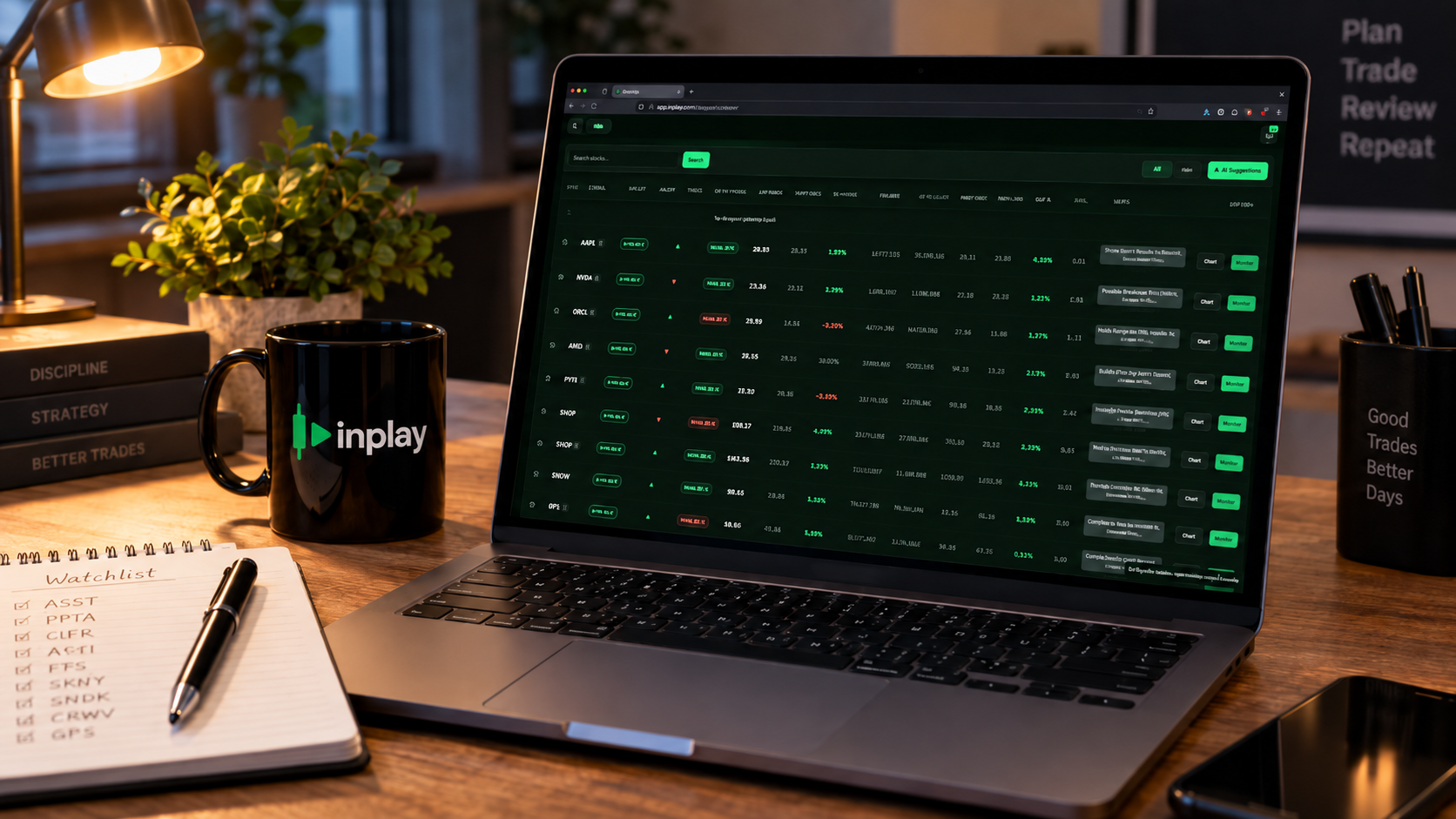
When a stock meets its criteria, InPlay brings it to your attention and provides context to help you understand why it has been identified.
This includes information such as price gaps, relative volume, VWAP alignment, and relevant market catalysts.
InPlay also identifies Alpha candidates, a more selective classification that combines multiple market factors to highlight stocks for closer examination.
Rather than starting every morning with a blank watchlist, you can use InPlay to build a shortlist of active stocks and focus your attention on the setups that fit your trading strategy.
And because the market doesn't stop changing after the opening bell, InPlay continues monitoring activity throughout the trading session.
It won't eliminate trading risk, guarantee profitable opportunities, or replace the need for a tested strategy.
But it can make one of the most time-consuming parts of day trading considerably easier.
Spend Less Time Searching and More Time Trading
Making a living from day trading takes discipline, experience, sufficient capital, and a strategy that can withstand losing periods.
Finding the right stocks is only one part of that process, but it's a part you shouldn't have to tackle entirely on your own.
Whether you're developing your first trading strategy or refining an established daily routine, InPlay provides a simpler way to discover stocks experiencing unusual activity.
Find what's moving. Understand why it matters. Decide whether it fits your strategy.
Find Today's In-Play Stocks
Discover active US stocks, monitor market momentum, and build a more focused trading watchlist with InPlay.finance.
Risk disclosure: Day trading involves substantial risk and may not be suitable for everyone. This article is for educational purposes only and does not constitute personalised financial advice or a guarantee of trading results.


